The Myth of the High-Tech Harvest
When most people first hear the word hydroponics, they envision a scene straight out of a science fiction movie. They see sterile white rooms, glowing purple lights, and complex networks of bubbling tubes and whirring pumps. It looks less like gardening and more like a chemistry experiment. This image is exactly why so many aspiring hobbyists never plant their first seed.
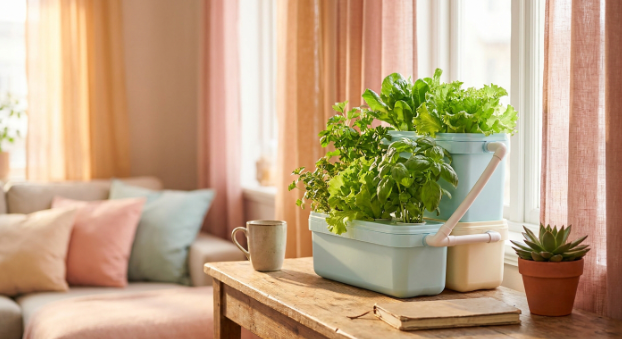
I am here to tell you that the secret to beginning hydroponics successfully isn’t found in a sensor or a circuit board. In fact, I believe your first garden should be as ‘lazy’ as possible. While the professionals are busy calibrating digital meters, the happiest hobbyists are usually the ones with a simple bucket and a sunny windowsill. If you want to actually enjoy this hobby rather than troubleshoot it, you need to prioritize simplicity over science.
The Jargon Trap: Why to Ignore VPD and DLI
If you start getting started in hydroponics by browsing expert forums, you will immediately run into a wall of acronyms. You’ll hear about Vapor Pressure Deficit (VPD) and Daily Light Integral (DLI). Sites like Grow With Hydroponics provide excellent calculators for these metrics, but for a beginner, they are a total trap.
VPD is essentially a fancy way of measuring how the air’s temperature and humidity affect a plant’s ability to ‘breathe.’ DLI is just a measurement of how much light a plant gets over 24 hours. Are these things important for a commercial greenhouse trying to squeeze an extra 5% yield out of a crop? Absolutely. Are they important for you, growing a head of lettuce in your kitchen? Absolutely not.
When you focus on advanced data points, you stop looking at the plant and start looking at a screen. For your first grow, your goal isn’t to be a data scientist; it’s to see if you can keep a plant alive without soil. If the leaves look green and the plant is standing tall, you are doing fine. Don’t let the ‘lab science’ of the industry intimidate you out of the game before you’ve even sprouted a seedling.
Passive vs. Active: The Case for No-Power Growing
In the world of hydroponics, systems are generally split into two categories: active and passive. Active systems use electricity, pumps, and timers to move water and nutrients to the plants. Passive systems rely on simple physics, like capillary action or just letting the roots sit in the water.
Many beginners are tempted by the ‘active’ gadgets because they look impressive. However, I strongly advocate for following the ‘passive’ methods often highlighted in manuals from the Ohio State University Extension. Why? Because pumps fail. Power goes out. Timers get misconfigured. When an active system fails while you’re at work, your plants can die in hours because they have no reservoir of soil to fall back on.
A passive setup—often called the ‘Kratky Method’ or a simple wick system—has no moving parts. It is virtually fail-proof. By removing the mechanical complexity, you remove 90% of the stress. You don’t need to be a plumber or an electrician to grow a salad. You just need a container that holds water and a way to keep the plant upright.
Focus on Greenery Over Gadgets
There is a massive temptation to buy every shiny tool on the market. You’ll see mentions of HydroBuddy, a powerful open-source nutrient calculator used by professional chemists at Science in Hydroponics. It is a brilliant piece of software, but for a hobbyist, it is the equivalent of buying a Ferrari to drive to the mailbox.
Is hydroponics easy? It can be, but only if you master basic plant observation first. Professional tools are designed to solve professional problems. As a hobbyist, your ‘tool’ should be your eyes. Instead of obsessing over nutrient chemistry calculations, spend that time looking at your plants.
Are the lower leaves turning yellow? (They might need more food).
Is the stem stretching and looking thin? (It needs more light).
Are the roots white and fuzzy or brown and slimy? (Brown means they need more air).
These observations are a thousand times more valuable than a digital readout. When you rely on gadgets, you never learn the ‘language’ of the plant. If the sensor breaks, you’re helpless. If you learn to watch the greenery, you become a gardener for life.
The Counterargument: When Tech Actually Matters
Now, don’t get me wrong. High-tech systems have their place. Organizations like ZipGrow and Bootstrap Farmer do incredible work showing how vertical farming and automated greenhouses can feed entire communities. If you decide to turn your hobby into a business, you will eventually need those sensors and professional-grade nutrient protocols to stay profitable.
But you aren’t a commercial farm yet. You are a person with a new hobby. Just as you wouldn’t learn to cook by buying a commercial-grade pizza oven, you shouldn’t learn to grow by building a pressurized aeroponic tower. You have to earn the right to use the gadgets by first succeeding with the basics.
Conclusion: Start Small, Start Lazy
The best way to ensure you are still gardening six months from now is to make sure your garden doesn’t feel like a second job. By ignoring the jargon, choosing passive systems, and focusing on the plants rather than the hardware, you set yourself up for a win.
If you’re ready to dive in, look for the simplest ‘small-scale’ guides from university extensions like the University of Minnesota. They offer jargon-free, step-by-step instructions that prioritize your success over selling you a fancy kit. Grab a bucket, get some seeds, and keep it simple. Your plants—and your stress levels—will thank you.