Think you killed your plant by forgetting to water it? The real culprit is likely the opposite. Overwatered plants don’t drown; their roots suffocate when water displaces oxygen in soil 10,000 times faster than you’d expect.
Key Takeaways
- Overwatering kills plants not by flooding them, but by starving their roots of oxygen – a process called root suffocation.
- Oxygen moves approximately 10,000 times slower through water than through air, meaning waterlogged soil acts as an effective seal around the root zone.
- Above-ground symptoms like drooping and yellowing can appear within just 3-5 days of waterlogging – well before root rot ever sets in.
- Root rot is the end stage of oxygen deprivation, not the beginning – catching the warning signs early makes all the difference.
- Smarter watering habits focused on soil oxygenation – not just moisture levels – are the real fix, and the deeper science behind why is covered throughout this post.
Most people assume a dying plant means they forgot to water it. The truth is almost always the opposite. Overwatering is one of the most common – and most misunderstood – ways home gardeners unintentionally harm their plants. And the mechanism behind the damage is rarely what people expect.
Your Plant Isn’t Drowning – It’s Suffocating
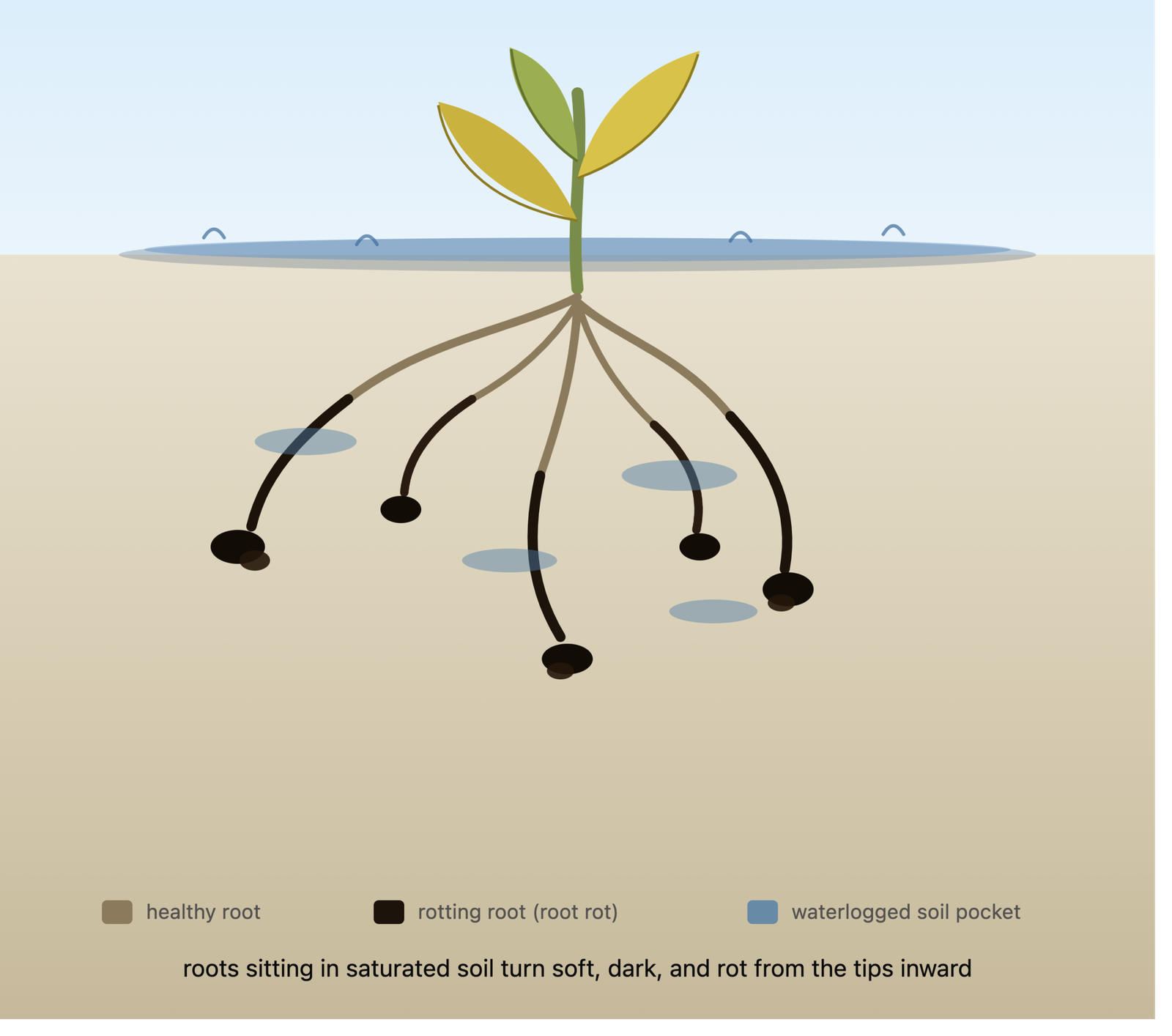
Here’s the paradox: the water itself doesn’t kill an overwatered plant – the oxygen that water displaces does. Excess soil moisture pushes out the tiny air pockets that roots depend on for gas exchange. Once those air pockets are gone, roots can no longer breathe. The plant essentially suffocates underground while looking perfectly normal from above – at least for a few days.
This is the core of what’s sometimes called the “oxygen paradox” of overwatering: giving a plant more water – something intuitively associated with care and nourishment – triggers a cascade of oxygen deprivation that can ultimately be fatal. Understanding this flips the entire mental model of how watering works.
For growers dealing with mysterious plant decline, this concept is covered in depth in a guide from NoSoilGardening.com on common reasons hydroponic plants die, which highlights root oxygenation as one of the most overlooked – and most critical – factors in plant health across all growing systems.
Why Roots Need Oxygen to Survive
Roots Breathe Like You Do
Roots are living tissue. Like every other living cell in a plant, they require oxygen to carry out aerobic respiration – the process that converts sugars and nutrients into usable energy. Without that energy, everything slows: cell division, water absorption, nutrient transport. Growth stalls. The plant starts operating on fumes.
This process cannot simply be paused and restarted without consequence. Roots that go without oxygen for even short periods begin to suffer real, measurable damage at the cellular level.
No Oxygen Means No Nutrient Uptake
Here’s something that surprises many gardeners: nutrients can be sitting right there in the soil, and the plant still can’t use them if the roots lack oxygen. Nutrient absorption is an active, energy-dependent process. No oxygen means no energy, and no energy means nutrients stay locked out – even in a richly amended, well-fertilized growing medium. A plant can literally starve in a full pantry.
How Wet Soil Becomes an Oxygen Trap
Water Displaces the Air Pockets Roots Depend On
Healthy soil has a porous structure full of micro-channels, with ideal porosity around 50% – typically split between air and water. Those air-filled spaces are the delivery system for oxygen reaching root surfaces. When water floods the soil, it pushes that air out. The more saturated the soil, the fewer air pockets remain, and the less oxygen is available for root uptake. Overwatering is, at its core, a soil aeration problem.
Oxygen Moves 10,000x Slower Through Water Than Air
This single fact explains why waterlogged soil becomes dangerous so quickly. Oxygen diffuses through water approximately 10,000 times slower than it does through air. That means even if there’s a small amount of dissolved oxygen in the water surrounding the roots, it’s effectively inaccessible – it can’t reach root cells fast enough to sustain respiration. From the root’s perspective, waterlogged soil is not a wet environment. It’s a sealed one.
Water that is itself low in dissolved oxygen compounds the problem further, actively pulling oxygen away from the root zone rather than contributing any to it.
What Happens Inside the Root When Oxygen Runs Out
Anaerobic Respiration and Its Toxic Byproducts
When oxygen runs out, root cells don’t simply shut down – they switch to a backup system: anaerobic respiration. This is a far less efficient energy pathway, and it comes with a serious downside. Anaerobic respiration produces toxic byproducts – including ethanol and acetaldehyde – that accumulate in root tissue and begin to destroy it from the inside.
At the same time, the oxygen-deprived soil environment becomes hostile in another way. Beneficial aerobic microbes – the ones that help break down organic matter and support root health – begin to die off. In their place, anaerobic pathogens thrive. The soil chemistry shifts in a direction that actively works against the plant, creating what’s sometimes called a “black layer” of anaerobic activity just below the surface.
Spot the Warning Signs Before It’s Too Late
Root Color Changes: White to Brown to Black
Healthy roots are white or off-white. As oxygen deprivation sets in, roots begin to discolor – first turning light brown, then darker brown, and eventually black as tissue death progresses. If the soil is pulled back and the roots look tan or muddy rather than crisp and white, that’s an early warning worth taking seriously. Brown roots that are still firm may be salvageable. Roots that are black and mushy have already begun to decompose.
Above-Ground Symptoms Can Appear Within Days
Gardeners often assume that underground damage takes a long time to show up visually. That’s not always the case. Visible symptoms of oxygen deprivation – drooping leaves, yellowing, uneven or stunted growth – can appear within just 3 to 5 days of waterlogging. The frustrating part is that these symptoms mimic drought stress almost exactly. A wilting plant in wet soil looks identical to a wilting plant in dry soil, which leads many gardeners to water more, accelerating the damage.
A few warning signs to watch for:
- Limp or drooping leaves despite visibly moist soil
- Yellowing that starts at older, lower leaves
- Slowed or completely stalled growth during the growing season
- A slightly sour or musty smell coming from the soil
- Roots that look brown or gray when the plant is removed from its pot
Root Rot Is the Final Stage – Not the Starting Point
One of the most important reframes in plant care: root rot is the result of the problem, not the cause. By the time root rot is visible, the plant has already been through the full cycle of oxygen deprivation, cellular damage, and anaerobic toxin buildup. Root rot is a fungal condition caused by pathogens like Pythium that thrive specifically in anaerobic, oxygen-starved soil. They don’t create the problem; they move in once oxygen deprivation has already done the foundational damage.
This distinction matters because it changes what the actual intervention needs to be. Treating root rot as a disease without addressing the underlying oxygen problem almost guarantees a recurrence.
Stop the Cycle: Oxygen-First Watering Habits
The fix requires a mindset shift – from watering on a schedule to watering based on what the soil actually needs. The goal isn’t to keep soil moist; it’s to keep it aerated between waterings. That means letting the top layer dry out enough that air can re-enter the soil before the next watering. A simple moisture meter removes the guesswork entirely – water when it reads dry, not before.
A few habits that protect root oxygen levels:
- Check soil moisture before every watering, not on a set day-of-the-week schedule.
- Use well-draining soil mixes with perlite or coarse material to maintain air channels even when wet.
- Ensure pots have drainage holes – without them, water has nowhere to go and soil stays saturated.
- Aerate compacted soil periodically with a chopstick or skewer to reopen air pathways.
- Let soil fully recover between deep waterings rather than topping off with small amounts frequently.
Water Temperature Matters Too
Cold water holds more dissolved oxygen, but extreme temperature swings – very cold or very warm water – can stress roots. Water temperatures above 75°F (24°C) significantly reduce dissolved oxygen and create conditions that favor harmful pathogens. Keeping water temperatures between 64-72°F (18-22°C) is a reliable middle ground: gentle on roots and carrying enough dissolved oxygen to support healthy respiration without introducing thermal stress.
Water Less. Oxygenate More. Save Your Plants.
The single most important shift a home gardener can make is to stop thinking of watering as an act of generosity and start thinking of it as a balance between hydration and aeration. Roots need both water and oxygen – and in waterlogged soil, they can only get one. Every time the soil is allowed to partially dry between waterings, air flows back in, oxygen reaches the roots, and the plant gets what it actually needs to function.
The plants that thrive aren’t the most heavily watered ones. They’re the ones whose roots can breathe.
For more expert guidance on keeping plants healthy from the roots up, visit NoSoilGardening.com – a resource dedicated to smarter, soil-aware growing for home gardeners at every level.