Key Takeaways
- Both tower gardens and stacked tray systems qualify as “vertical farming” – the real space-maximizing power comes from going vertical in the first place, not from which specific orientation you choose.
- The type of hydroponic system (NFT, DWC, or Ebb & Flow) significantly influences performance, working in conjunction with plant arrangement (towers or horizontal trays) to optimize growth for specific crops.
- Towers excel at packing plants into a tiny footprint; stacked trays give crops a more natural growing orientation with more even light and nutrient distribution.
- Plant spacing is a shared requirement across both layouts – get it wrong, and neither setup will reach its potential. More on why that matters below.
There’s a moment most hydroponic hobbyists hit when they’re staring at their grow space – whether it’s a spare bedroom, a garage corner, or a balcony – and thinking: how do I fit more plants in here? The answer is almost always to go vertical. But the follow-up question, towers or stacked trays, is where things get genuinely interesting.
Going Vertical Is the Space Maximizer – Your System Refines the Results
Here’s the short answer upfront: going vertical is what maximizes space. Vertical hydroponic setups can significantly increase yields, with some reports indicating up to five times higher yields or even 10-15 times more crop per square foot compared to traditional field agriculture. They also use substantially less space, often as much as 90% less land or water than traditional horizontal growing – a dramatic difference that holds true whether plants are in towers or layered trays. The layout orientation (tower vs. tray) refines and shapes the results, but it isn’t the core driver.
What matters more is the hydroponic system running underneath it all. Nutrient Film Technique (NFT), Deep Water Culture (DWC), and Ebb & Flow each deliver water and nutrients differently, and that delivery method shapes which layout actually performs best for a given crop. For hobbyists digging into the details of how these systems interact with layout decisions, this overview of hydroponic systems is a solid place to build that foundation.
What “Vertical Farming” Actually Means
The term “vertical farming” gets used loosely, so it’s worth clarifying. Vertical farming simply means stacking or elevating plants to grow more in the same floor area – it doesn’t specify a crop type, hydroponic method, or even whether soil is involved. Hydroponics, aeroponics, aquaponics, and even traditional soil-based growing can all fall under the vertical farming umbrella if plants are being grown in layers.
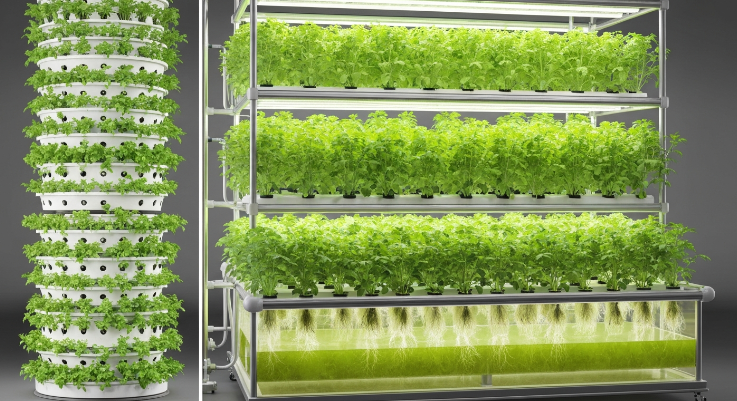
Within hydroponic vertical farming specifically, there are two primary structural approaches: towers (plants growing from ports along a vertical column) and stacked trays (horizontal growing trays layered on multi-level racks). Both maximize indoor space. How they do it – and for which crops – is where they diverge.
Towers vs. Stacked Trays: The Real Distinction
A tower garden suspends plants along a central vertical structure, with each plant tucked into a port on the side of the column. A stacked tray system uses multi-layer racks to run horizontal growing channels or flat trays at different heights. In both cases, the goal is the same: more plants per square foot of floor space. The difference is in how the plants are oriented relative to gravity, light, and nutrient flow – and that difference has real downstream effects.
NFT, DWC, and Ebb & Flow: How System Type Shapes Your Layout
The hydroponic method chosen has a larger impact on outcomes than stacking orientation alone. NFT runs a thin film of nutrient solution along shallow channels – it works well in both stacked tray and tower configurations, particularly for leafy greens. DWC suspends plant roots directly in aerated, nutrient-rich water and is most naturally suited to horizontal tray setups. Ebb & Flow periodically floods and drains a grow tray, making it a flexible option for layered tray systems with larger crops. Choosing the right system for the layout – and the crop – is the real optimization lever.
Where Tower Gardens Win
Maximum Density in Minimal Floor Space
Tower gardens are purpose-built for tight spaces. A single tower column can hold dozens of plants while occupying only a few square feet of floor space, making them a natural fit for small apartments, balconies, and urban grow rooms. For anyone working with genuinely limited square footage, the density advantage of towers is hard to beat.
Multi-layer tray racks achieve vertical stacking too, but they still require horizontal tray surface area at each level. Towers eliminate that constraint almost entirely – the “growing surface” is the column itself.
Best Crops for Tower Systems
Not every plant belongs in a tower. The best performers share a few key traits: lightweight, shallow-rooted, and compact. Leafy greens and herbs dominate this category.
- Lettuce & Spinach – shallow roots, fast turnover, tight spacing (4-8 inches)
- Kale – generally suitable for tower ports, though larger varieties may need more spacing or pruning to maintain airflow and prevent overcrowding
- Basil, Cilantro, Chives – herbs thrive with 6-10 inch spacing in tower setups
Larger fruiting plants – tomatoes, cucumbers, bell peppers – can be grown in towers, especially compact or dwarf varieties, but they typically require more attentive care, consistent nutrients, and often additional structural support due to their root mass and physical size. Horizontal tray or drip systems are often a more straightforward and efficient fit for these crops, particularly for hobbyist setups.
The Real Challenges of Vertical Towers
Uneven Light Exposure Across the Tower
In any tower system, light doesn’t reach every plant port equally. Plants near the top of a tower may sit closer to the light source; plants near the bottom can end up in partial shade. This creates uneven growth – some plants develop faster and larger, while others lag behind. Regular rotation of the tower (or periodic repositioning of plants) helps, but it adds a management step that tray systems don’t require to the same degree.
Nutrient Distribution: How Gravity Affects Vertical Flow
In tower systems, nutrient solution is pumped upward before trickling down through the ports. This vertical flow can create challenges for consistent nutrient delivery to all plants, potentially leading to variations in nutrient access. Clogging risks can also be higher in tower systems due to the design of the flow path. Plants positioned near the very top or bottom of a tower may be more susceptible to inconsistent access to water and nutrients, which can contribute to smaller or less uniform harvests.
Where Tray Stacking Has the Edge
Natural Growth Orientation and Even Resource Distribution
Stacked tray systems let plants grow the way they naturally want to: horizontally, parallel to the ground, bending toward light. That alignment with natural growth patterns reduces stress on the plant and creates more consistent conditions across the crop. Every plant on a given tray sits at the same distance from the light source and receives nutrient solution delivered uniformly across the channel or raft.
In a well-designed stacked tray system, the odds that any individual plant is shortchanged on light or nutrients are significantly lower than in a tower. That consistency translates directly to more uniform yields – which matters whether growing for personal use or selling at a local market.
Baby Greens: Strong Fit for Trays, but Towers Work Too
Baby greens (microgreens, arugula, early-harvest lettuce) are particularly well-suited to stacked tray systems, especially DWC setups using high-density rafts. These fine-seeded crops benefit from the flat, even surface of a tray and the uniform moisture of a DWC float. High-density rafts – one of the most efficient formats for baby greens – aren’t compatible with tower port systems, which limits tower use for this specific crop category. That said, towers are still a solid option for mature leafy greens and herbs; the baby greens limitation is crop-specific, not a general tower weakness.
Plant Spacing: The Factor Both Layouts Share
No matter which layout is chosen, plant spacing is non-negotiable. Correct spacing directly affects root development, airflow, light distribution, disease prevention, and overall yield. Crowd plants in either a tower or a tray system and the results suffer – poor airflow raises disease risk, roots compete for oxygen and nutrients, and canopy shading reduces light penetration.
Spacing by Crop Type
Crop Type Recommended Spacing Best-Suited Systems Leafy Greens (Lettuce, Spinach) 4-8 in (10-20 cm) NFT, DWC, Vertical Towers Herbs (Basil, Chives) 6-10 in (15-25 cm) Wick, NFT, Aeroponics, Towers Tomatoes 12-18 in (30-45 cm) Drip Systems, DWC Peppers 18-24 in (45-60 cm) DWC, Ebb and Flow Cucumbers 18-24 in (45-60 cm) Drip Systems, Trellised NFT
Spacing guidelines aren’t just about fitting plants in – they’re about giving each plant the room it needs to perform. In a vertical system where space is already being pushed to its limits, getting spacing right is what separates a dense, productive setup from a crowded, underperforming one.
Match Your Layout and System to Your Crops, Space, and Goals
The tower vs. tray debate doesn’t have a universal winner – and that’s actually good news. The right answer is the one that fits the specific situation.
- Extremely limited floor space? Tower gardens pack in more plants per square foot.
- Growing baby greens or high-density rafts? Stacked tray systems with DWC are the cleaner choice.
- Prioritizing uniform yields with less daily management? Stacked trays have the consistency edge.
- Growing leafy greens and herbs in a compact urban setup? Towers are purpose-built for exactly that.
- Running fruiting crops like tomatoes or cucumbers? Neither towers nor compact tray racks are ideal – horizontal drip or DWC systems with proper spacing win here.
The hydroponic system type – NFT, DWC, Ebb & Flow – should always be selected based on the crop first, then the layout built around it. Going vertical is the right instinct for maximizing space; the layout and system together determine how well that vertical space actually performs.